I continue to research adolescents’ online presence on Ofcom reports. Here are the key facts:
Drawn to drama: Kids gravitate to dramatic, short-form videos on social media
Rise of ‘split-screening’: Trend for watching two videos at once
More careful, less creative: Youngsters more socially self-conscious, posting fewer videos.
Screen time: 16–24-year-olds more likely to take social media break to manage wellbeing
According to Ofcom’s annual study into children’s relationship with media and the online world, children are gravitating to ‘dramatic’ online videos which appear designed to maximize stimulation but require minimal effort and focus
Almost all children aged 3 to 17 (96%) watch videos on video-sharing sites and apps. More than half of all youngsters view live-streamed video content (58%), which increases to 80% among 16-17-year-olds.
YouTuberemains the most popular site or app, used by nearly nine in ten 3–17-year-olds (88%), although short-form video apps TikTok (50% to 53%) and Snapchat (42% to 46%) saw significant increases in use over the last year. [2]
Gossip, conflict, controversy, extreme challenges and high stakes – often involving large sums of money – are recurring themes. ‘Commentary’ and ‘reaction’ video formats, particularly those stirring up rivalry between influencers while encouraging viewers to pick sides, were also appealing to participants.
These videos, popularised by the likes of Mr Beast, Infinite and JackSucksAtStuff, are often short-form, with a distinct, stimulating, editing style, designed to create maximum dramatic effect. This involves heavy use of choppy, ‘jump-cut’ edits, rapidly changing camera angles, special effects, animations and fast-paced speech.
Social media… not all that social
Children are much less likely to post their own videos (32%) than to watch them (96%). Correspondingly, children in the Media Lives study said they are seeing less content created by their friends, and even when they do see it, are interacting with it less. For these children, social interaction between friends online is now primarily confined to chat apps or message functions within apps, rather than on public feeds.
With their social media feeds dominated by professionalized content, kids tend to post rarely, to limited circles, or not at all. Some children were creating edited or filtered videos and photos but were saving them in their ‘drafts’, with no intention of ever posting them.
Striking the screen-life-wellbeing balance
Ofcom's research also includes a deep-dive into the online lives of older teenagers and young adults aged 16 to 24. This group are among the most avid online users, typically using nine online communication sites or apps on a regular basis – compared to six for the average adult internet user. Nearly nine in 10 (87%) use all four types of online communications – social media, messaging, video-sharing and live-streaming – significantly higher than the average user (61%).
As with younger children, Snapchat and TikTok have grown in popularity among 16-24s over the last year, overtaking Instagram as the social media platform they said they used most often. BeReal – an app that asks users to share, once a day, a real-life, unfiltered photo with friends – has also seen notable growth among this age group, with use increasing from 9% to 22% between spring and autumn 2022.
Just over half of social media users aged 16-24 (51%) thought they spent too much time on social media – up from 42% in 2021, and significantly higher than average (32%). But they are also setting boundaries. This group were significantly more likely than average to take a deliberate break from using any social media apps (36% vs. 25% average) or delete apps to avoid spending too much time on them (32% vs. 23% average).
Older teens and young adults are also generally more likely to seek out online content and services that support their well-being (89% vs. 78% of all online adults). Specifically, use of websites or apps designed to help with relaxation (44% vs. 34%), improve mood (43% vs. 26%), aid sleep (37% vs. 22%), manage anxiety (33% vs. 19%), follow a fitness program or health-tracker (29% vs. 24%), meditate (21% vs. 15%) or feel energised (20% vs. 11%) was higher than average among this 16-24 age group of internet users.
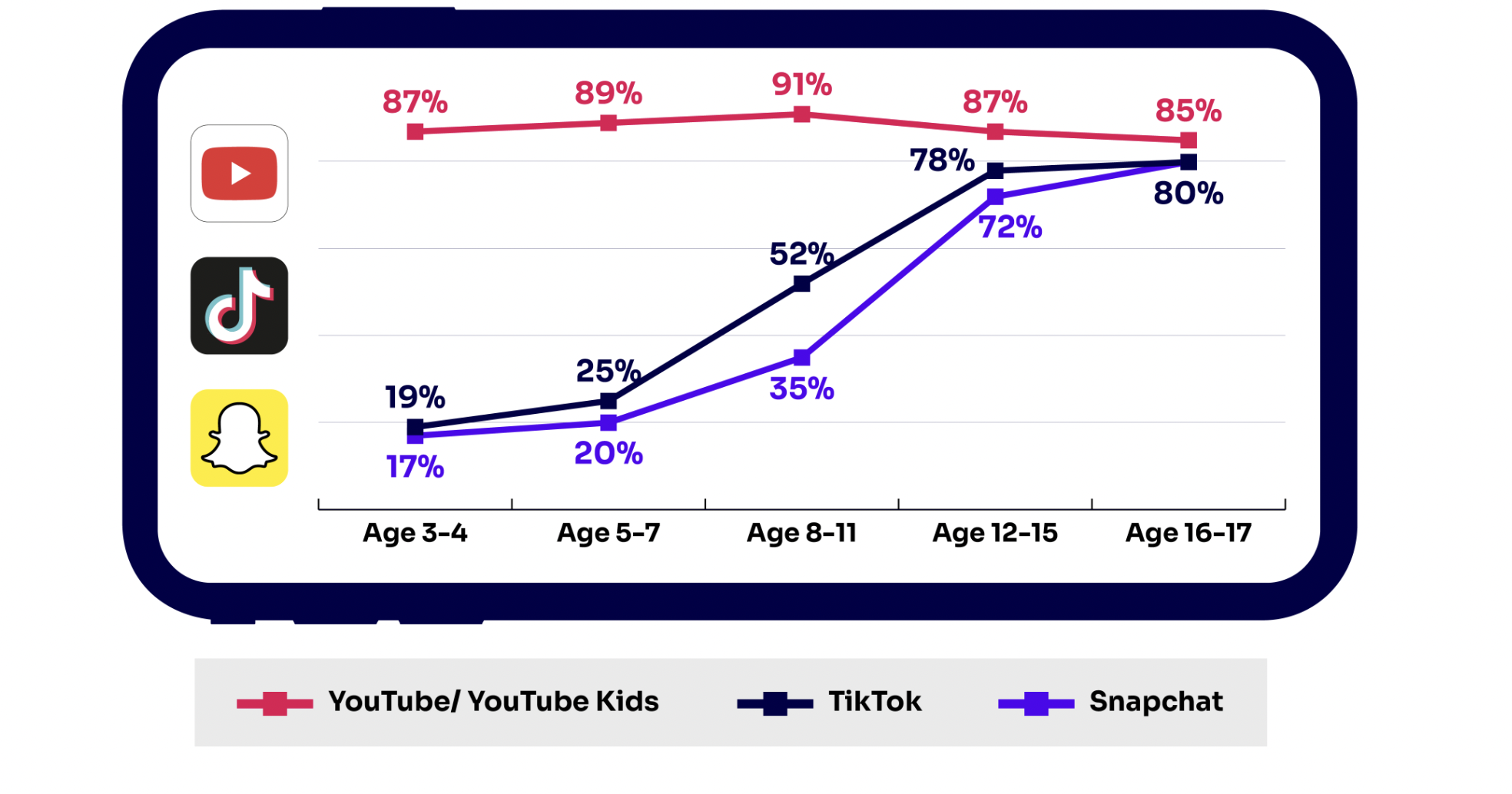
Use of YouTube/YouTube Kids is almost universal across children aged 3-17. TikTok and Snapchat are much more likely to be used by older children. Note these proportions are those that use these platforms, not that have a profile on them.